 Lofoten Islands Tours
Lofoten Midnight Sun: the Dates, and What to Do With Them

The Lofoten midnight sun runs for about 55 days, from roughly 25 May to 18 July in Svolvær, and it changes the shape of a trip more than any other feature of the place. Nothing closes at dusk because there is no dusk. Hikes start after dinner, boats run in gold light at eleven at night, and the only thing standing between you and a 20-hour day is your own sense of when to stop.
Quick answer
In Svolvær the sun stays above the horizon continuously from about 25 May to 18 July. It does not set, it circles: dropping towards the sea around midnight, skimming the horizon, then climbing again. July is the warmest month at about 13.6°C on average and also the busiest; late May and June give you the same light with fewer people and the driest weather of the year.
Key takeaways
- Exact window in Svolvær: about 25 May to 18 July, roughly 55 days of unbroken daylight.
- The tour that only exists inside it: midnight sun kayaking at Eggum, $115.43, rated 4.9 from 406 reviews.
- June is the driest month at about 35 mm of rain, against 85 mm in January.
- Late-evening boat departures from Svolvær run with the low sun behind the peaks the whole way back.
- Coming outside the window? Northern lights take over from late August.
The Exact Dates, and What They Mean
Fifty-five days without a sunset
Svolvær sits at 68 degrees north, well inside the Arctic Circle, so the sun is continuously above the horizon from about 25 May to 18 July. The dates shift by a day or two across the archipelago and by a little more if you travel further north in Norway; at the Arctic Circle itself, near Bodø, you get only a handful of days around the solstice.
Outside those dates the effect fades slowly rather than stopping. Through most of May and into early August the nights are white: the sun dips below the horizon but the sky never goes properly dark, which is close enough for hiking at midnight and useless for aurora.
Circling, not setting
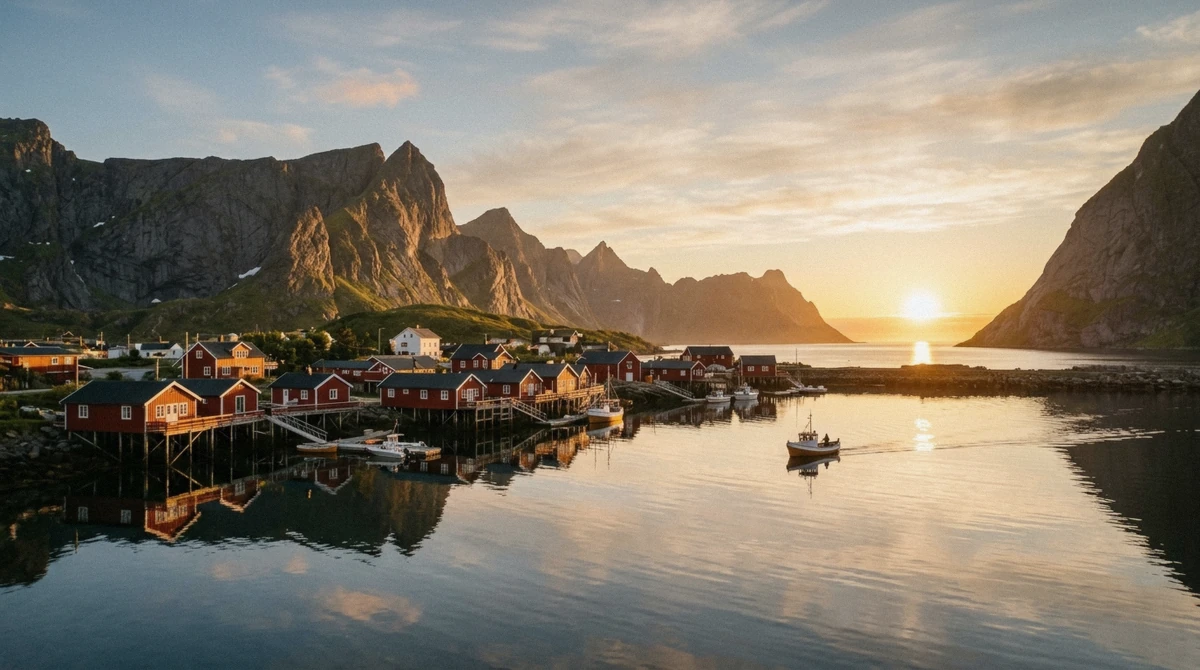
What people underestimate is the light quality. Further south, the golden hour is an actual hour. Here the sun tracks sideways along the horizon for half the night, so the low gold light stretches from about nine in the evening to two in the morning.
That is the practical reason to shift your day. The middle of a Lofoten summer day is flat, hazy and full of cars; the middle of the night is quiet, gold and empty. Photographers work the hours everyone else sleeps through, and the villages at Reine and Hamnøy are effectively yours between midnight and six.
It is not a warm sun
July averages about 13.6°C in Svolvær and it is the warmest month of the year. The Gulf Stream keeps this coast far milder than its latitude suggests, but 24-hour daylight does not mean heat.
Pack for a Scottish summer rather than a Mediterranean one: fleece, windproof, and something waterproof. June is the driest month at around 35 millimetres of rain against 85 millimetres in January and October, so the odds are decent, but the wind off the water is constant.
What to Do at Midnight
The activities that get better after ten
Everything outdoors improves once the day-trippers leave. The beaches at Haukland and Uttakleiv empty out, the car park below Reinebringen frees up, and the road west stops being a queue.
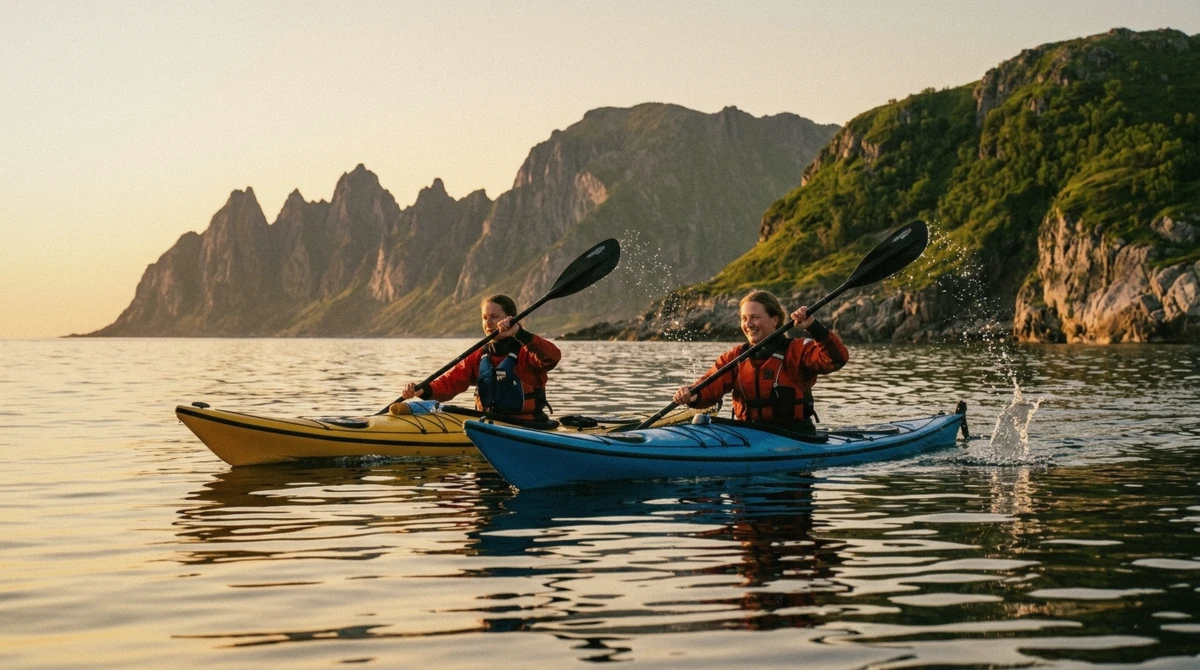
The one experience built specifically around the light is the kayak trip at Eggum on the northwest coast of Vestvågøy: three hours on open Atlantic water, timed so the sun drops towards the horizon and lifts again while you are on it. It costs $115.43, holds a 4.9 rating across 406 reviews, and it does not exist outside this window.
| Hour | What works | Why then |
|---|---|---|
| 18:00 to 21:00 | Dinner in Svolvær or Henningsvær | Kitchens still open; you are eating before the good light, not during it |
| 21:00 to 23:00 | Kayaking at Eggum, evening boat departures | Low gold light on the water, the sun behind the peaks on the way back |
| 23:00 to 01:00 | Hamnøy bridge, Reine, Sakrisøy | The photograph everyone queues for at noon, with nobody in it |
| 01:00 to 03:00 | Haukland, Uttakleiv, Skagsanden beaches | Sun at its lowest, long shadows, empty sand |
| 03:00 to 06:00 | Reinebringen or Ryten if you are hiking | Cool air, no crowds, and full light on the summit |
Driving at night is the real trick
The E10 in July is a single road carrying campervans, rental cars and coaches, which is why 60 kilometres from Leknes to Reine can take two hours in the middle of the day. Between 22:00 and 07:00 that same drive runs clean.
So build the trip backwards: sleep late, do the indoor and village things in the afternoon, and drive when the road empties. It is the single biggest quality-of-trip decision you can make in a Lofoten summer, and it costs nothing.
Which Midnight-Sun Week Fits You
If you want the light with the fewest people
Late May and the first half of June. The sun is already up around the clock, the roads are clear and cabins cost a fraction of July.
If you are coming to hike
Late June to early August, when the high trails are clear of snow and you can start a climb at nine in the evening.
If you want to kayak under the sun
Book the Eggum trip for a mid-trip evening, so a swell cancellation still leaves you another night.
If you are travelling with children
June rather than July. Sleep is the hard part of a midnight-sun trip and quieter villages make the routine easier to hold.
If you also want the northern lights
You cannot have both. The aurora season restarts in late August; the northern lights page has the dates.
A midnight sun day, as it actually runs
One version of a full-light day in late June, based in Svolvær with a car.
-
11:00
Late start
You went to bed at three. Coffee in Svolvær, and the harbour is already working.
-
13:00
Museum or village hour
Lofotr at Borg, or Henningsvær galleries. The flat middle of the day is for indoor things.
-
16:00
Boat out of Svolvær
An afternoon Trollfjord departure, back on the quay in time to eat.
-
20:00
Dinner
Kitchens close earlier than you expect, even in summer. Eat before the light turns.
-
22:00
Drive west
The road empties. Leknes to Reine in the time the map says, for once.
-
23:30
Hamnøy and Sakrisøy
The bridge, the yellow cabins, the reflection. No queue.
-
01:00
Uttakleiv
Sun at its lowest over the sea, and the whole beach to yourself.
-
03:00
Back east
An hour and a half of empty road in full daylight, which is a strange and excellent thing.
Sleeping in Daylight
It genuinely disrupts people
The first night is fine, the second is when it catches you. Without darkness your body loses its cue to wind down, and the classic pattern is three days of feeling wired followed by one of collapsing at nine in the evening and missing the best light.
Most rorbuer and hotels have blackout curtains, but coverage varies and older cabins often have thin ones. Bring an eye mask regardless; it weighs nothing and it is the difference between a good week and a tired one.
- Eye mask, non-negotiable, even where blackout curtains are promised
- Earplugs, because summer villages are lively at midnight too
- A fixed bedtime you actually keep, even in full sun
- Caffeine cut-off in the afternoon; the light is doing enough already
- Melatonin if you use it at home, taken at a consistent hour
- One planned late night rather than five accidental ones
Which weeks to book
Late May and the first half of June give you the full light with the lowest visitor numbers and the driest weather. Roads are clear, cabins are cheaper and the ferry queue at Moskenes has not started.
July is peak everything. Full car parks at Reine, vehicle queues for the Bodø ferry, and accommodation in the western villages at its highest price of the year. The light is identical to June's.
Our recommendation: aim for the first two weeks of June. You get the same midnight sun, better odds on rain, and the archipelago to a fraction of the July crowd.
What the weather actually does in the light months
Summer here is mild rather than warm and wetter than the brochures let on. June is the driest month of the year at around 35 millimetres of rain, July and August climb from there, and the wind off the Norwegian Sea is constant on any exposed coast.
That matters more for planning than the temperature does. A still, clear midnight in late June is one of the best evenings available anywhere in Europe; the same date under a front is grey, flat and closed in. Give yourself several evenings rather than one.
It also shapes what you pack. Waterproof over warm, gloves even in July for boat decks, and sunglasses you will genuinely use at midnight.
| Month | Average high | Rain | What it means |
|---|---|---|---|
| May | About 9°C | Moderate | Midnight sun starts about the 25th; snow still on the high trails |
| June | About 12°C | Driest month, around 35 mm | The best combination of light, weather and quiet |
| July | About 13.6°C, the warmest | Moderate | Same light, peak crowds, highest prices |
| August | About 13°C | Wetter | Warmest sea, first dark nights returning at the end |
Midnight Sun Questions
When is the midnight sun in Lofoten?
In Svolvær the sun stays continuously above the horizon from about 25 May to 18 July, roughly 55 days. Dates shift by a day or two across the archipelago. Either side of that window the nights are white rather than dark, which is bright enough to hike at midnight from early May into early August.
What can you do at midnight in Lofoten?
Everything outdoors, with fewer people. The kayak tour at Eggum is built around the hour, the beaches at Haukland and Uttakleiv are at their best after one in the morning, and the villages at Reine and Hamnøy are empty of the daytime queues. Driving is also far easier once the E10 clears after ten.
How do you sleep during the midnight sun?
Bring an eye mask and keep a fixed bedtime. Blackout curtains are common but not universal, and older cabins often have thin ones. The usual pattern is three wired nights followed by a crash, so plan one deliberate late night rather than drifting into five.
Is the midnight sun warm?
No. July averages about 13.6°C in Svolvær and it is the warmest month of the year. Twenty-four hours of daylight at 68 degrees north still means fleece, windproof and waterproof layers, especially on the water where the wind is constant.
Which month is best for the midnight sun in Lofoten?
June, and preferably the first half of it. You get the same continuous light as July, the driest month of the year at around 35 millimetres of rain, lower prices and none of the July queues at the Moskenes ferry or the Reine car parks.
Can you kayak under the midnight sun in Lofoten?
Yes, and it is the one experience that only exists inside the window. The Eggum trip runs three hours on open Atlantic water on the northwest coast of Vestvågøy, costs $115.43 and is rated 4.9 across 406 reviews. It is beginner-friendly but it launches into exposed water, so it cancels for swell more often than a sheltered paddle would.
Can you see the northern lights during the midnight sun?
No. The aurora is present year-round but the sky never gets dark enough to show it between late May and mid-July. The season restarts in late August; the northern lights page covers the timing.