 Lofoten Islands Tours
Trollfjord Cruise: Four Boats, One Fjord, a $48 Spread

A Trollfjord cruise leaves the quay in Svolvær, runs east across Vestfjorden into the Raftsundet strait, and turns into a gap in the rock 100 metres wide. Four operators sail that route daily and each sells you the same water, so the only real decision is the hull you sit in: an open RIB at speed, a covered local boat, or a hybrid-electric catamaran that cuts its engine inside the fjord. One more thing to clear up first, because the search results confuse it constantly: MS Trollfjord is a Hurtigruten ship, not this trip.
Quick answer
Trollfjord cruises from Svolvær cost $108.72 to $156.36 per person and take two to three and a half hours, round trip from the quay. The fjord itself is 2 km long, its mouth measures about 100 metres across, and no road goes there, so a boat is the only practical way in. All four boats run year-round, wind rather than season is what cancels them, and white-tailed eagles are the reliable wildlife on the way.
Key takeaways
- Most booked: the silent hybrid-electric cruise at $156.36, 4.8 from 3,503 reviews, 3.5 hours.
- Cheapest: the Go2Lofoten covered boat at $108.72 for three hours, run by a local family.
- Fastest: both RIB safaris at $125.40, two hours, flotation suits handed out on the quay.
- Highest rated of the fast boats: the 4.9-rated RIB across 887 reviews.
- Searching for MS Trollfjord instead? That is a Hurtigruten ship, not a Svolvær day cruise.
Every Trollfjord Cruise from Svolvær
Four departures, one fjord. Prices are per person as listed on 6 August 2026, all with free cancellation up to 24 hours ahead.
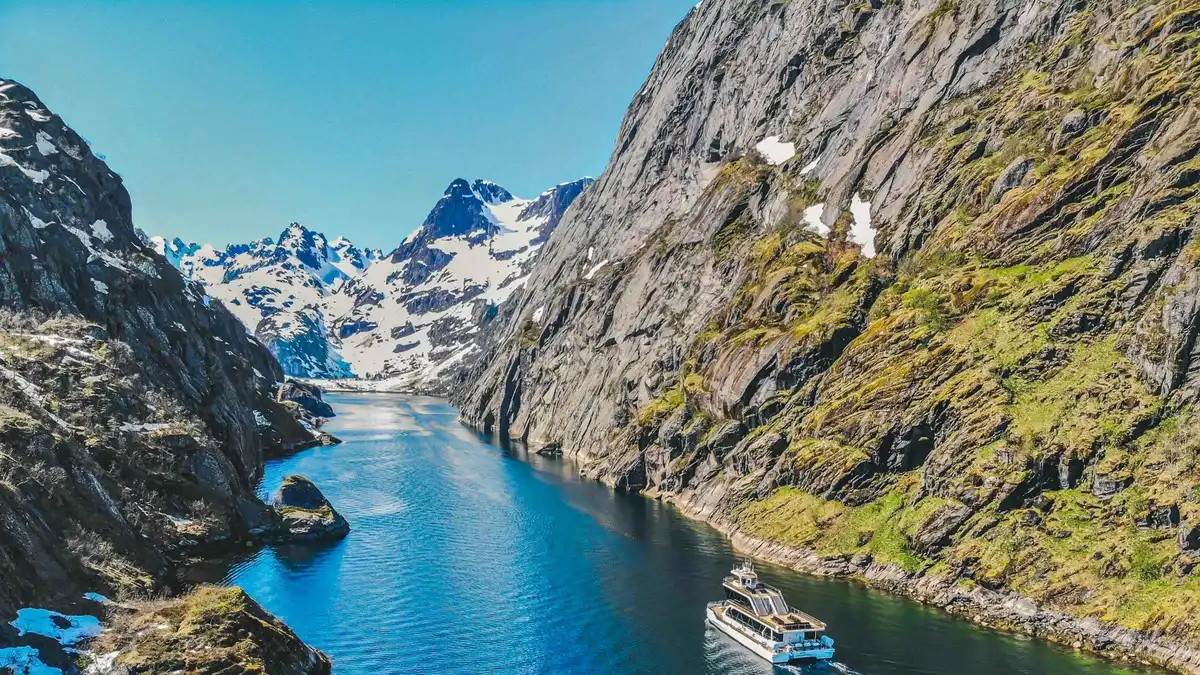 from $156.36Most reviewed — 3,503
 Silent Trollfjord Cruise from Svolvær by Hybrid-Electric Catamaran
Brim Explorer's purpose-built catamaran runs on battery inside the fjord, so the engine noise stops and you hear the water off the walls. Three and a half hours…
Check Availability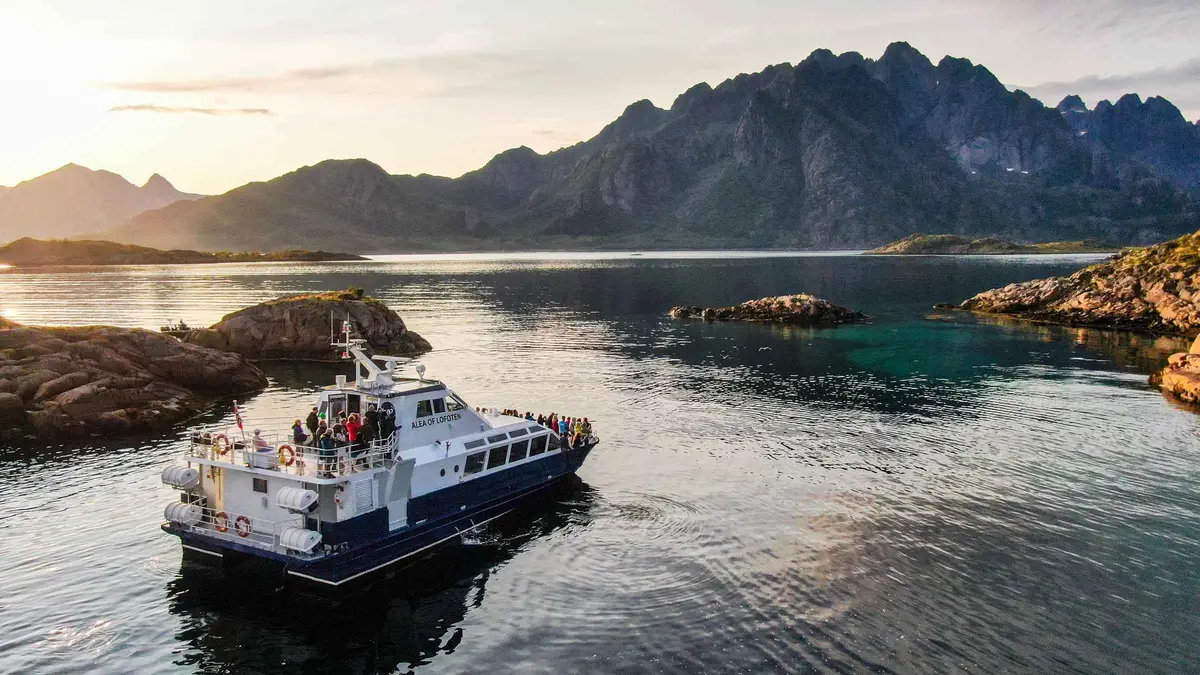 from $108.72Cheapest Trollfjord trip
 Trollfjord Cruise & Sea Eagle Safari with a Lofoten Family Operator
Go2Lofoten is a local family business running a covered boat, three hours out of Svolvær, with the area's history told on the way. The lowest price on this…
Check Availability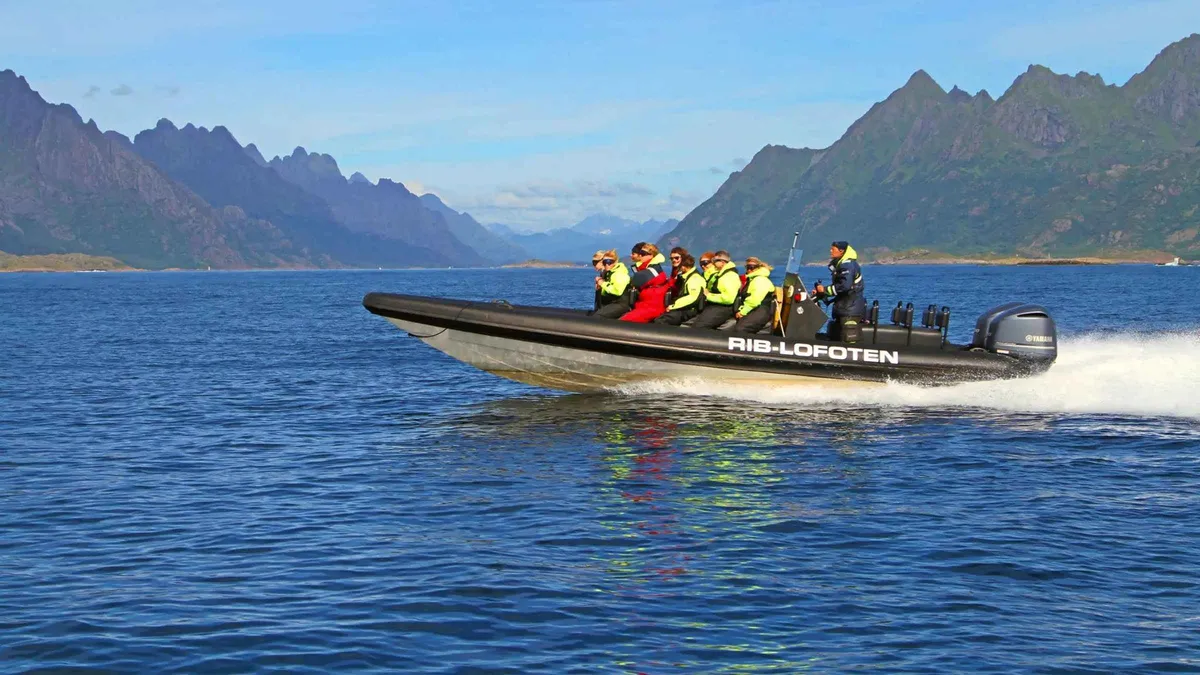 from $125.40Fastest way in — 2 hours
 Two-Hour RIB Sea Eagle Safari to Trollfjord
A rigid inflatable that covers Raftsundet at speed, with flotation suits handed out on the quay in Svolvær. You sit outside the whole way, which is the point…
Check Availability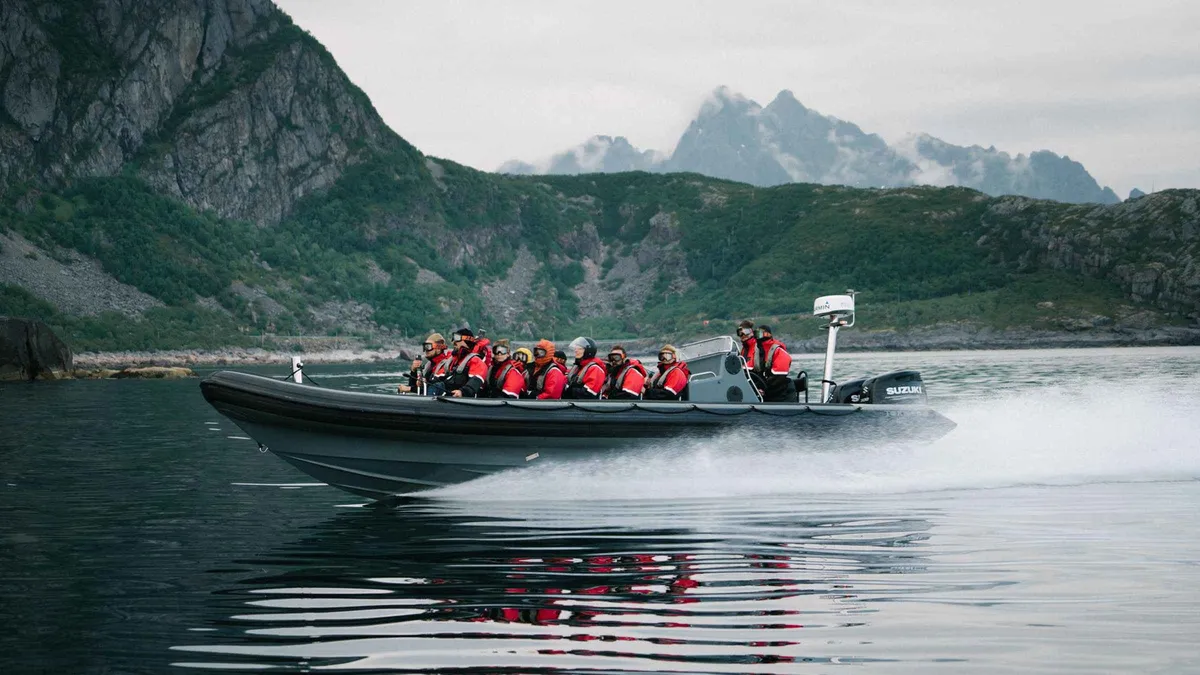 from $125.40Highest rated RIB — 4.9
 RIB Trollfjord & Sea Eagle Safari, Rated 4.9
The same two-hour RIB run into Trollfjorden, with the strongest rating of the fast boats across 887 reviews. Steep walls, beaches on the way out, and enough speed…
Check AvailabilityThe Four Boats, Compared
Read the Boat column first. Price, comfort and how much of the day you lose all follow from it.
| Cruise | Boat | Time | Book | Price | Rating | Best for |
|---|---|---|---|---|---|---|
| Silent Trollfjord cruise | Hybrid-electric catamaran | 3.5 hours | Check | $156.36 | 4.8 (3,503) | Hearing the fjord instead of an engine |
| Go2Lofoten cruise & eagle safari | Covered local boat | 3 hours | Check | $108.72 | 4.6 (171) | The lowest fare, and a family crew |
| RIB sea eagle safari | Rigid inflatable, open | 2 hours | Check | $125.40 | 4.8 (1,101) | Speed, and eagles over an open deck |
| RIB Trollfjord safari | Rigid inflatable, open | 2 hours | Check | $125.40 | 4.9 (887) | The best-rated fast boat |
What Trollfjord Actually Is
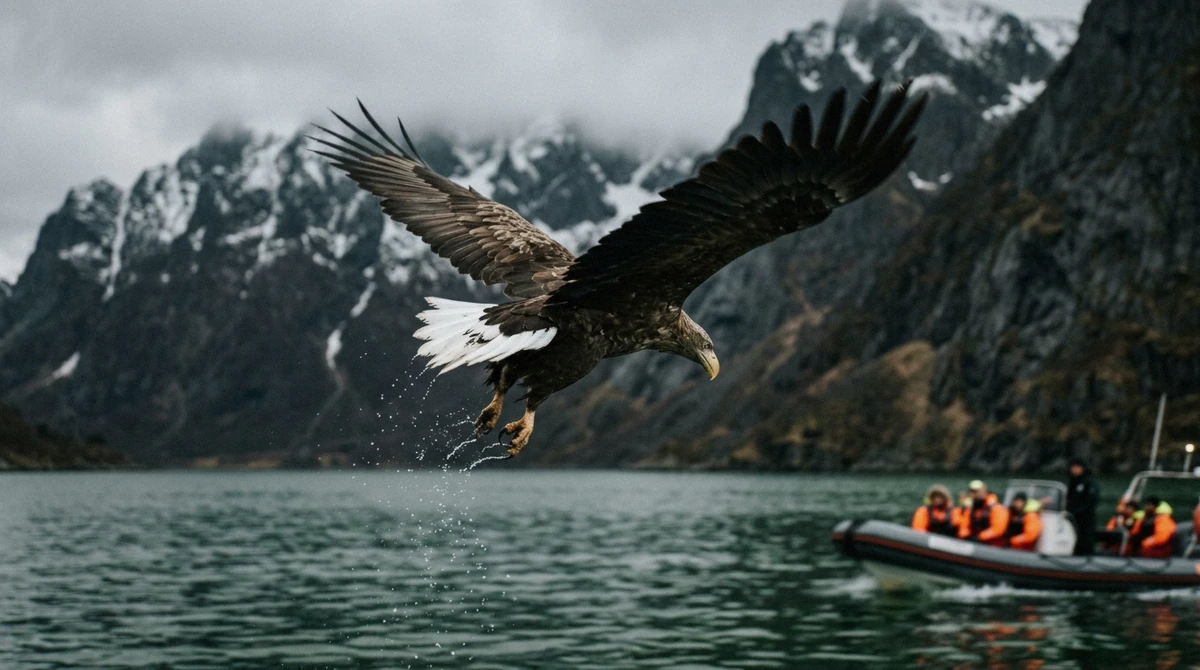
Two kilometres long, one hundred metres wide
Trollfjord cuts two kilometres into Austvågøya from the Raftsundet strait, and at the junction the opening is roughly 100 metres across. Walls of 600 to 900 metres rise on both sides, close enough that a boat's engine note comes back off the rock a beat later than you expect.
The skipper slows almost to a stop at the mouth. On a covered boat that is the moment the deck empties and everyone goes outside; on a RIB you are already outside and the driver kills the throttle so the wind noise drops. Inside, the fjord widens slightly, the water goes black and flat, and waterfalls come down the walls after rain.
The name comes from the trolls the walls suggested to people who lived here before anyone was selling tickets. Nothing about the place is subtle.
There is no road, and there is no shortcut
You cannot drive to Trollfjord, park above it, or reach a viewpoint on foot from the E10. Trollfjord can only be reached by boat, or on foot by a rough 10 km hike over broken ground that a handful of people do each summer with proper kit.
That is why every listing you find for it is a boat. It also means the fjord is quiet in a way roadside Norwegian landmarks are not: on a mid-week morning outside July you may share it with one other vessel, or none.
The route out, which is not dead time
From Svolvær the boats pass under Svolværgeita, the two-horned rock spire above the town, and cross open water with the Lofoten Wall standing to the south. Skrova comes up to starboard, a small island with a whaling past and a few hundred residents.
Then Raftsundet narrows between Austvågøya and Hinnøya, the swell disappears, and the crew starts watching the ridgelines. Most eagle sightings happen here, before the fjord itself.
The Battle of Trollfjord, 6 March 1890
A rope across the mouth
During the 1890 Lofoten cod season the fish crowded into Trollfjord. Steam-powered fishing boats, new that decade and vastly more efficient than anything under oars, dragged a rope across the mouth of the fjord to shut the traditional open-boat crews out of the catch.
The rowboat men cut it. What followed on 6 March 1890 became known as Trollfjordslaget, the Battle of Trollfjord: hundreds of fishermen in open boats against the steamers, hoses and fists, in a fjord a hundred metres wide.
Why it still matters here
The fight was not just a brawl over one season's fish. It was the moment industrial capital and coastal labour collided in the Lofoten fishery, and Parliament took the fishermen's side: in March 1891 it amended the Lofoten Act to ban the use of nets during the Lofoten fishery, protecting the smaller boats' access.
Johan Bojer wrote the fight into Den siste viking, and it is still the story Lofoten tells about itself. Ask a skipper on any of these four boats and you will get a version of it, usually as you pass the exact spot the rope was strung.
RIB, Covered Boat or Hybrid-Electric
Same fjord, same hour of the day, three different experiences of it.
| Boat | Time out | Price | What you get | Trade-off |
|---|---|---|---|---|
| Open RIB | 2 hours | $125.40 | Speed, flotation suit supplied, eagles at eye level over an open deck | Wind and spray the whole way, and no shelter if the weather turns |
| Covered local boat | 3 hours | $108.72 | Indoor seating, commentary on the fishery and the battle, the lowest fare | Slower out, wildlife a little further off |
| Hybrid-electric catamaran | 3.5 hours | $156.36 | Battery power inside the fjord, heated saloon, outdoor decks, panoramic glass | The longest trip and the highest fare |
Prices per person from the operators' GetYourGuide listings, checked 6 August 2026.
MS Trollfjord Is a Ship, Not This Cruise
Same name, entirely different product
Search Trollfjord cruise and half the results are Hurtigruten's MS Trollfjord, a coastal ship named after the fjord. It was built in 2002, refurbished in 2023, and carries around 500 passengers. In 2026 it sails the North Cape Line in winter and the Svalbard Line in summer, on voyages measured in days and priced accordingly.
If what you want is a multi-day coastal voyage with a cabin and a restaurant, that is the ship. If what you want is to be inside Trollfjord this afternoon and back in Svolvær for dinner, it is one of the four boats above.
Do the big coastal ships enter the fjord?
Sometimes. Hurtigruten and Havila ships sailing the Raftsundet leg will nose into Trollfjord when conditions and schedule allow, turn on their own length, and come back out. It is a genuine highlight of that stretch and it is also entirely at the captain's discretion, weather and daylight permitting.
What you get from a big ship is scale: a 120-metre vessel turning inside a 100-metre gap is a spectacle. What you do not get is the silence, the low angle or the eagles a few metres above an open boat, and you cannot book it as a two-hour trip from Svolvær.
Eagles, Season and What Cancels a Trip
White-tailed eagles are the reliable wildlife
Raftsundet and Trollfjorden hold one of the densest white-tailed eagle populations in Europe. It is the largest bird of prey in northern Europe, with a wingspan reaching 2.65 metres, and the crews know the nesting pairs by sight.
On the RIB safaris the crew throws fish and the birds drop in close over an open boat, which is the reason those tours score as high as they do. From a covered deck the same birds work further off unless you go outside. No operator guarantees a sighting, and in heavy rain the birds sit it out, but on a normal day you will see several.
When to go, and what will stop you
The boats run every month of the year, including through the polar night from about 7 December to 5 January. Summer gives you green walls, long light and the busiest quay; winter gives you snow to the waterline, a short blue day and the chance of aurora on an evening departure.
What cancels a Trollfjord cruise is wind. Swell at the mouth of Raftsundet grounds the RIBs first and the covered boats later, and October through March produces most of it, though a summer low can shut the fjord for two days in July. Book the trip early in your stay so a cancellation leaves you a day to rebook.
| Season | What it looks like | Which boat suits it |
|---|---|---|
| June to August | Midnight sun to 18 July, green walls, warm decks | Any; the RIB is at its most comfortable |
| September to October | Autumn colour, first aurora, rising wind | Covered boat on marginal days |
| November to January | Polar night, blue twilight, snow to the shoreline | Covered or hybrid, for the heated saloon |
| February to April | Cod season, returning light, aurora still on | Any; February is the classic Lofoten winter week |
| May | Snow on the peaks, midnight sun from about 25 May | Any; the quiet month before the crowds |
What to wear
The RIB operators hand out full flotation suits at the quay, which handle wind and most spray. They do not cover your hands or your ears, so gloves and a hat matter more than a heavier coat.
On the covered boats you can travel in what you would wear in town, but the outside decks are where the eagles are, so bring the layer anyway. Sunglasses are worth carrying from May to August, including for a late evening sailing, because the light off the water at midnight is stronger than people expect.
- Warm hat and gloves, every month, on every boat
- Windproof layer to wear under the flotation suit on a RIB
- Sunglasses May to August, evening departures included
- A strap or pouch for your phone; people lose them over the side
- Seasickness tablets an hour before if open water bothers you
Booking a Trollfjord Cruise Without Surprises
What the fare covers
On the RIB safaris the price includes the flotation suit, which is the only piece of equipment that matters, and usually a hot drink at the turnaround. On the covered boats you get a seat indoors, commentary and a galley selling coffee and something to eat; the catamaran adds a proper saloon, outdoor decks and, on some sailings, an underwater camera feed shown on screens.
What none of them include is transport to Svolvær, which is on you, and none of them are a meal cruise. Budget separately for lunch, because a three-and-a-half-hour trip lands you back on the quay hungry.
All four cancel free up to 24 hours before departure through the platform, which is worth more here than almost anywhere else given how fast the weather moves.
Timing your slot
Morning departures are the safe pick in summer: wind usually builds through the day, and a cancellation at 09:00 still leaves you an afternoon to rebook into. Evening slots in June and July are the ones people remember, because the low sun sits behind the peaks the whole way back, and they sell out first.
In winter the daylight window is short. From late November to mid-January there are effectively a few hours of blue light around midday, so the midday departure is not a preference, it is the only real option unless you want a dark fjord.
Book the trip for your first full day in Lofoten rather than your last. Everyone who ends up disappointed here booked the fjord for the afternoon before their flight.
Children, seasickness and mobility
The covered boats are the family answer: indoor seating, a toilet, and no wind in a small child's face for two hours. The RIB operators run flotation suits in children's sizes but set their own minimum ages, and the ride is a genuine pounding in any swell, so read the age line on the listing before you book for a family.
Vestfjorden is open water and it moves. If you are prone to seasickness, take tablets an hour before rather than at the quay, sit low and central on a covered boat, and understand that the RIB is the rougher ride even though it is the shorter one.
Step-aboard access varies with the tide and the boat. A RIB requires climbing down into a pontoon boat from a floating pontoon; the covered vessels are easier but not step-free. If mobility is a factor, message the operator through the platform before booking, because the crews answer these questions honestly.
Photographing the fjord
Everything works against you: low light against bright sky, spray on the lens, and a deck that will not hold still. A wide lens beats a long one, because the walls are what you came for and they will not fit otherwise. Shutter speed above 1/500 handles the boat movement, and on a RIB you want your camera on a strap and inside a jacket between shots.
The eagles are the exception, and the reason people bring the long lens anyway. Pre-focus on the water where the crew is throwing fish, shoot bursts, and accept that most frames will be empty sky.
Inside the fjord itself the light is flat and cool. Do not fight it: the place photographs better as a study in grey and green than as an attempt at a postcard, and after rain the waterfalls give you the contrast the sky will not.
Where a Trollfjord cruise goes
Out of Svolvær harbour, east across the mouth of Vestfjorden, up Raftsundet and into the fjord. Round trip from the same quay.
- Svolvær Departure quay for all four cruises
- Skrova Island passed on the way out
- Raftsundet The strait where most eagles are seen
- Trollfjord 2 km long, 100-metre mouth, no road
Roughly an hour each way by covered boat, half that by RIB.
What people write after the fjord
The silence when they switched to electric inside the fjord was the best part. You hear waterfalls you would never notice over a diesel engine.
Fast, cold and brilliant. The suits keep you warm enough but bring a hat, and the eagles came so close on the way back that nobody bothered with their phones.
Small boat, local skipper, and he told us the story of the 1890 fight right where it happened. Cheapest trip we booked in Norway and the one we talk about.
Quotes come from the GetYourGuide listings for the cruises on this page.
Trollfjord Cruise Questions
Is a Trollfjord cruise worth it?
If you are in Lofoten for more than a day, yes. Trollfjord is the one landmark here that no road, bus or hiking trail delivers, and the boats are the only practical access. At $108.72 for three hours on the covered local boat it is also cheaper than most Norwegian fjord excursions. Where people feel short-changed is when they book a two-hour RIB expecting a scenic cruise: that trip is about speed and eagles, not lingering.
How much does a Trollfjord cruise cost?
From Svolvær, $108.72 to $156.36 per person. The Go2Lofoten covered boat is the cheapest at $108.72 for three hours, the two RIB safaris are $125.40 for two hours, and the hybrid-electric catamaran is $156.36 for three and a half. All four include free cancellation up to 24 hours before departure.
How many passengers are on Trollfjord?
If you mean MS Trollfjord, the Hurtigruten ship, it carries around 500 passengers; it was built in 2002 and refurbished in 2023. The day cruises out of Svolvær are far smaller: RIBs take about a dozen people, the covered boats a few dozen, and the Brim Explorer catamaran runs as a small-group sightseeing vessel with indoor and outdoor deck space.
What is the best time for a Trollfjord cruise?
Late May to mid-July for the midnight sun and green walls, February and March for snow and aurora with enough daylight to see the fjord. September gives you autumn colour and the first dark nights with far fewer people. The boats sail year-round, so the question is which Lofoten you want rather than whether the trip runs.
How long is the Trollfjord cruise from Svolvær?
Two hours on a RIB, three on the covered boat, three and a half on the catamaran, all round trip from the quay in Svolvær town centre. Roughly half of that is the run out and back through Raftsundet; the time actually inside the fjord is short on every boat, because the fjord is short.
Can you visit Trollfjord without a cruise?
Not realistically. There is no road, and the only land approach is a rough 10 km hike over difficult ground. If you have your own boat you can sail in; otherwise the four departures on this page, or a coastal ship that happens to enter on its Raftsundet leg, are the options.
Do Trollfjord cruises run in winter?
Yes, every month, including through the polar night from about 7 December to 5 January. Winter departures are quieter and colder, snow comes down to the waterline, and an evening sailing gives you a chance at the northern lights. Cancellations in winter come from wind, not from the darkness.
Which Trollfjord cruise is best?
For most people, the silent hybrid-electric cruise: heated saloon, outdoor decks, and the engine cut inside the fjord, which is the closest thing to how the place sounded before engines. On a tight budget take the covered boat at $108.72. Short on time or travelling with someone who wants the ride itself, take a two-hour RIB.
Will you see sea eagles on a Trollfjord cruise?
Usually. Raftsundet holds a dense population of white-tailed eagles, and the crews know where the pairs nest. The RIB safaris put you closest, since the birds come down over an open boat. Nobody guarantees a sighting, and heavy rain keeps the birds perched.
Do the big coastal ships enter Trollfjord?
Hurtigruten and Havila ships on the Raftsundet leg often nose in, turn inside the fjord and come back out, when weather, daylight and schedule allow. It is impressive to watch a 120-metre ship turn in a 100-metre gap, but it is at the captain's discretion and it is not something you can book as a day trip from Svolvær.
Do you need to book a Trollfjord cruise in advance?
In June and July, yes, especially for evening departures on the silent catamaran, which fills days ahead. From September to May you can often book the day before or the same morning. Since every listing cancels free up to 24 hours ahead, booking early costs nothing and protects the slot you actually want.
What happens if the cruise is cancelled?
Operator cancellations, which almost always mean wind, are refunded in full through the booking platform, and the crew normally offers the next available departure first. What is not refunded is the day you built around it, which is the argument for booking the fjord early in your stay rather than on your last afternoon.
Is there a toilet on board?
On the covered boats and the catamaran, yes. On the RIB safaris, no: it is a two-hour open boat with no facilities, so plan accordingly before you leave the quay in Svolvær.