 Lofoten Islands Tours
Full-Day Lofoten Tour to Å: Nine Hours, Four Villages

The full day Lofoten tour to Å is the answer to a problem the archipelago creates: the villages everyone comes to photograph sit 130 kilometres west of the town where all the boats leave, on one road, with paid parking that fills before nine in July. This tour puts a local guide in the driver's seat for nine hours, covers Reine, Hamnøy, Sakrisøy and Å, and costs $209.04 per person. Here is what those nine hours actually contain and when driving yourself makes more sense.
Quick answer
Nine hours, small-group minivan, pickup in Svolvær or Leknes, with a local guide and personal headsets. It runs west along the E10 to the four villages at the end of the archipelago: Reine, Hamnøy, Sakrisøy and Å, where the road stops at a stockfish museum and a bakery. It costs $209.04 per person and holds a 4.8 rating from 146 reviews. Stops are short because the distance is long; this is a photography-and-viewpoints day, not a hiking one.
Key takeaways
- $209.04 per person for the nine-hour tour, rated 4.8 from 146 reviews, free cancellation 24h ahead.
- Pickup in Svolvær or Leknes, which makes it the western answer for anyone without a car.
- Cheaper than a rental for one day: car hire runs 7,000 to 11,000 NOK a week.
- Covers Reine, Hamnøy, Sakrisøy and Å; it does not include Trollfjord, which is boat-only.
- In July it removes the parking problem entirely, which is worth more than it sounds.
The tour at a glance
9 hours, door to door
Svolvær or Leknes, small-group minivan
$209.04 per person
4.8 from 146 reviews
Local guide with personal headsets
Runs year-round; western light is short in December
Check dates for the day tour
Live departures for the nine-hour run west. Pick a date to see what is running that week.
What the Day Covers
Four villages, in order
The route runs west along the E10 from Svolvær or Leknes, through the middle of the archipelago and out onto Flakstadøya and Moskenesøya, where the mountains close in and the road runs out of land.
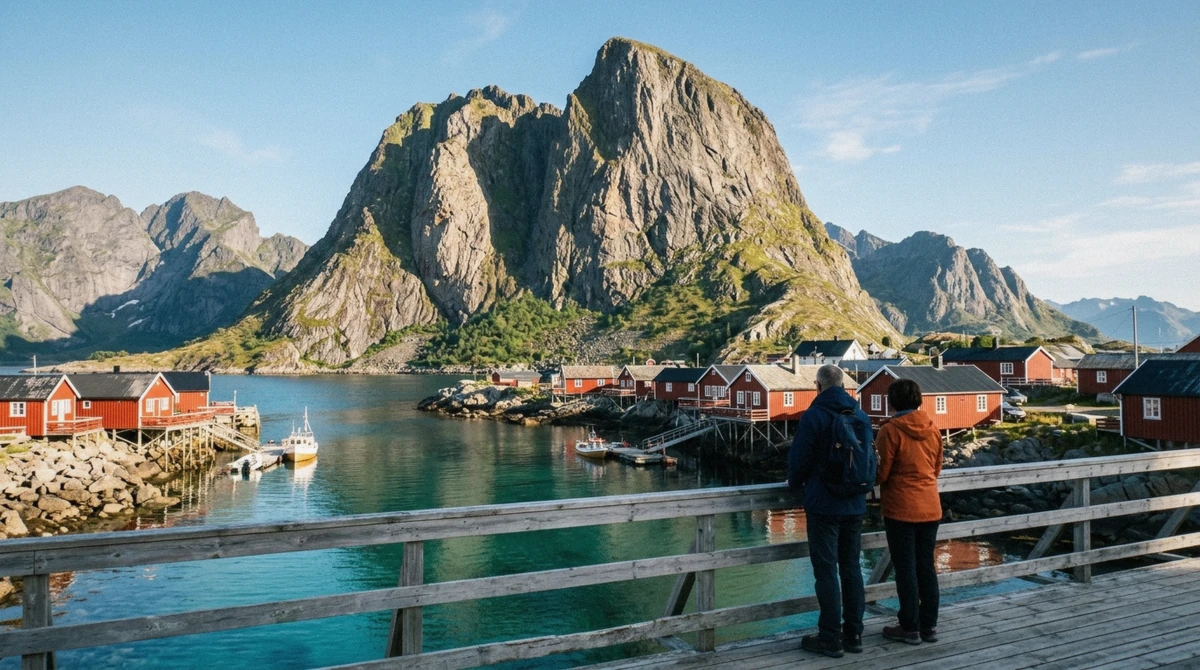
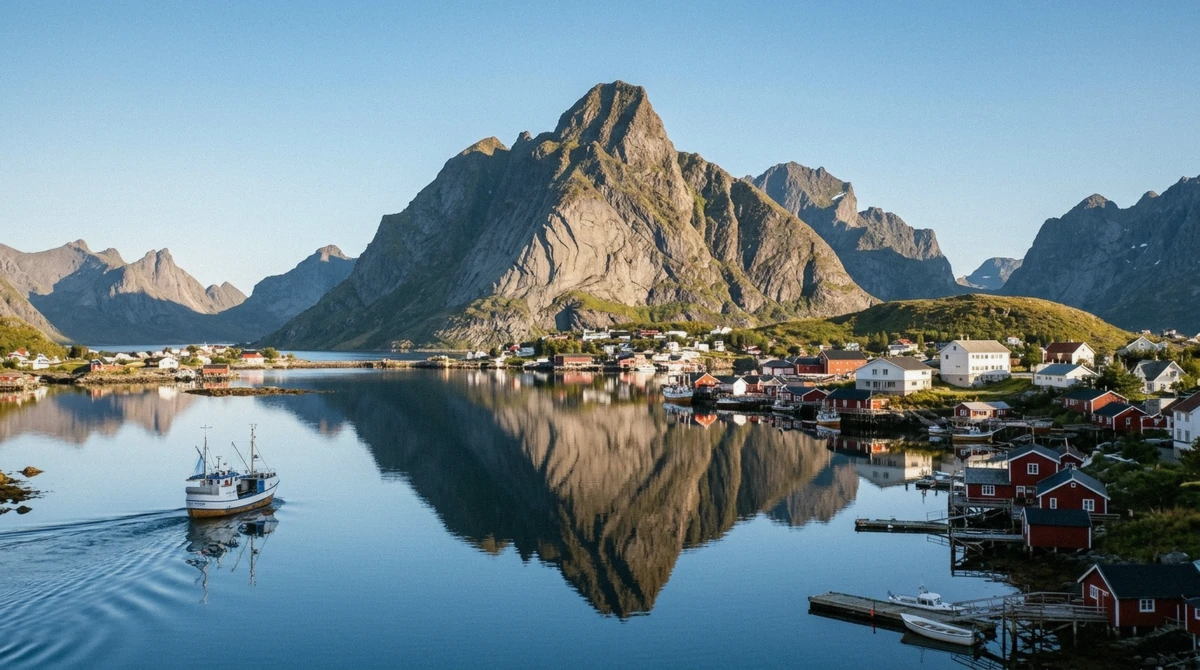
Reine sits on a spit under the Reinebringen ridge and is the village most people picture when they picture Lofoten. Hamnøy, a few minutes earlier on the road, has the bridge that gives you the photograph of red cabins with the peaks behind. Sakrisøy is the small one between them, with yellow cabins instead of red. Å, at the very end, keeps a stockfish museum, a working bakery in an old boathouse and the drying racks that carried Lofoten's export trade for a thousand years.
| Stop | Roughly | What you get | Time there |
|---|---|---|---|
| Departure | 08:00 to 09:00 | Pickup in Svolvær or Leknes | — |
| Middle of the archipelago | Morning | Viewpoints and photo stops on the drive west | Short |
| Hamnøy | Late morning | The bridge view towards Reine | 20 to 30 min |
| Sakrisøy | Midday | Yellow rorbuer, small harbour | 15 to 20 min |
| Reine | Early afternoon | The village, the water, Reinebringen overhead | 30 to 45 min |
| Å | Mid afternoon | Stockfish museum, bakery, drying racks | 45 to 60 min |
| Return | 17:00 to 18:00 | Back east along the E10 | — |
What it is not
It is not a hiking tour. Nobody climbs Reinebringen on a nine-hour day that also covers 260 kilometres of road, and the stops are measured in tens of minutes rather than hours.
It does not include Trollfjord, because Trollfjord has no road and is reached only by boat from Svolvær. If you want both, they are two separate days, and the fjord cruise belongs on the day you are in the east anyway.
And it is not a meal tour. There is a stop where you can buy food, usually the bakery at Å, but lunch is on you.
How the nine hours break down
Times shift with the season and the group, but this is the shape of the day.
-
08:30
Pickup
Svolvær or Leknes. From Svolvær the western end is 130 km away, so the day starts properly early.
-
09:30
West through the middle
Borg, Leknes and the Vestvågøy stretch, with viewpoint stops as the light allows.
-
11:30
Hamnøy bridge
The photograph. Twenty minutes, and in July you will not be alone.
-
12:15
Sakrisøy
Yellow cabins, a small harbour, and the least visited of the four.
-
13:00
Reine
The longest stop of the western cluster, with Reinebringen's staircase visible above you.
-
14:30
Å
End of the road. Museum, bakery, drying racks, and time to walk the whole village.
-
15:30
East again
The drive back, with the light behind you in summer.
-
17:30
Back in town
Nine hours after you left, in time for dinner in Svolvær.
What You Are Actually Looking At
Why these four villages and not others
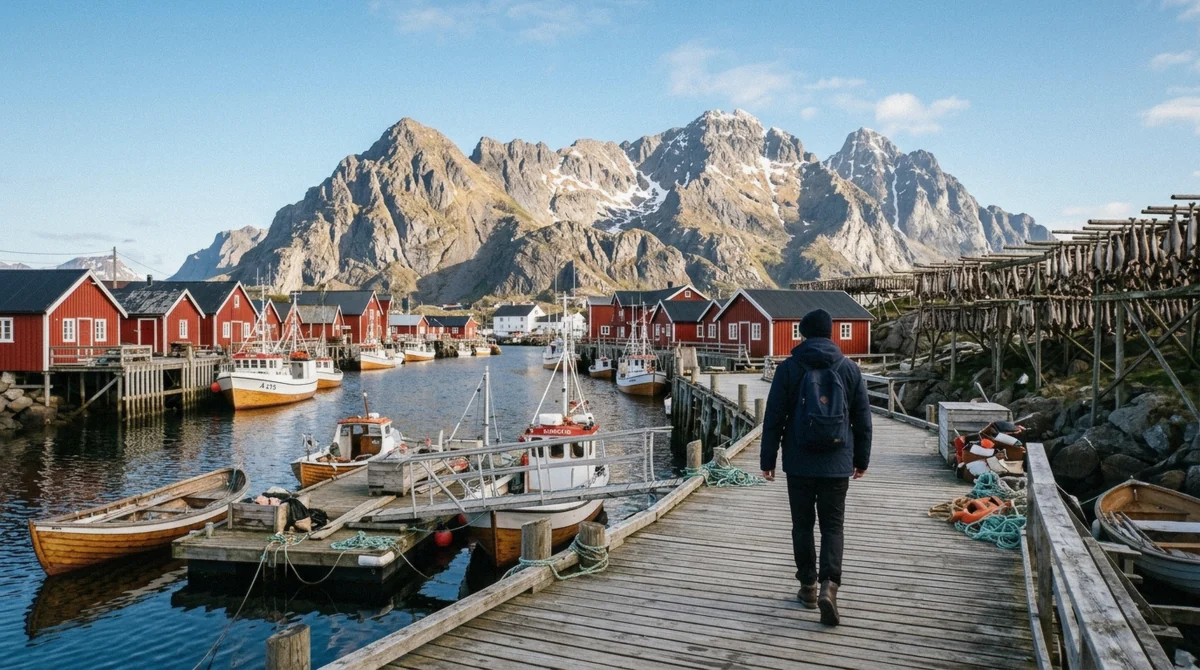
The western cluster exists because of the cod. Moskenesøya and Flakstadøya sit closest to the spawning grounds, so the fishing stations that grew there were the richest in Lofoten, and the rorbuer packed onto every scrap of flat rock were seasonal housing for crews who arrived each winter from all over northern Norway.
That is why the buildings sit on stilts over the water rather than up the hillside: a boat had to tie up at the door. It is also why the villages are so tightly packed against vertical mountain, and why the view from the Hamnøy bridge exists at all.
The guide's commentary is worth more here than in most places for exactly that reason. Without it, the stops are pretty. With it, they are a working landscape that has been doing the same job for a thousand years.
The stockfish, and what the racks are for
The wooden racks you pass all day are drying cod. Unsalted fish hung in cold, dry Arctic air keeps for years, and stockfish from Lofoten has been shipped to Italy and Portugal since the Middle Ages. Å has a museum built around the trade, in the buildings where it was actually run.
If you travel in February or March the racks are full and the smell is unmistakable. In summer they stand empty and the season is over, which surprises visitors who expected them to be a permanent display.
Who the day suits
It suits people without a car, people on a short trip who want the west covered once and covered properly, and anyone visiting in July who would rather not spend the day hunting for parking spaces.
It suits photographers less well than it looks, because the stops are timed and the light will be whatever midday gives you. If the picture is the point, rent a car and drive out at ten in the evening in summer, when the villages are empty and the sun is low.
And it does not suit hikers. Nine hours of road and four villages leaves no room for Reinebringen, which needs an hour up and an hour down before you have taken a photograph.
Guided or Self-Drive
The cost comparison, honestly
A rental car in Norway runs roughly 7,000 to 11,000 NOK a week, about $735 to $1,155, and Lofoten depots book out months ahead for summer. Hiring for a single day is possible but proportionally expensive, and you add fuel and paid parking at Reine, Hamnøy and the beaches.
So for one western day, two people, the guided tour is close to a wash and the driving is removed. For a week with hikes, beaches and trailheads on the list, the car wins clearly and it is not close.
| Guided tour | Self-drive | |
|---|---|---|
| Cost | $209.04 per person | 7,000 to 11,000 NOK a week, plus fuel and parking |
| Driving | None | 260 km round trip from Svolvær |
| Parking | Handled | Paid at Reine, Hamnøy and the beaches; full by nine in July |
| Flexibility | Fixed stops and timings | Total, including midnight light in summer |
| Commentary | Local guide on headsets | What you read yourself |
| Trailheads and beaches | Not covered | Reachable, which is the real argument for a car |
When the tour clearly wins
If you have flown in without a car, if you are here for three days or fewer, if you are visiting in July when the car parks are the binding constraint, or if you simply do not want to drive 260 kilometres on a single-lane road in a rental you are not used to.
It also wins in December, when the daylight window is short and the road west is a twilight drive at both ends. A guide who drives it weekly is the right person behind the wheel then.
Our recommendation: on a four-day first trip, take this tour on day three and keep the car money. On a week with hiking plans, rent the car and drive it yourself at ten at night in summer, when the road is empty and fully lit.
Questions About the Day Tour
How long is the full-day Lofoten tour to Å?
Nine hours door to door, which covers about 260 kilometres of round-trip driving from Svolvær plus the stops. Departures are in the morning, usually between eight and nine, and you are back in town by early evening. The listing shows the exact time for each date.
What does the Lofoten day tour to Å include?
A local guide, a small-group minivan and personal headsets, with stops at Hamnøy, Sakrisøy, Reine and Å plus viewpoints on the drive west. It does not include meals, museum entry or Trollfjord, which is reachable only by boat from Svolvær.
Where does the tour pick up?
Svolvær or Leknes, which is what makes it useful: those are the two towns with airports and accommodation clusters. From Svolvær you cover the full 130 kilometres west; from Leknes you join roughly in the middle and the driving day is shorter.
Is the guided day tour better than driving yourself?
For one western day without a car already booked, yes: renting for a single day costs a significant fraction of a week's hire, and the guide handles the parking that fills before nine in July. For a week with hikes and beaches on the list, a rental car is clearly better, since the trailheads sit off the main road with no service.
Is the tour suitable for children?
It is a long day in a vehicle with short stops, which suits older children and tests younger ones. The stops break it up and the villages are small enough to walk, but nine hours is nine hours. Families with small children often find a half-day boat trip the easier purchase.
What should you bring on a full-day Lofoten tour?
Waterproofs and a warm layer whatever the forecast said in the morning, since you will be out of the van at exposed viewpoints. Add sturdy shoes for short walks at each village, cash or card for the bakery at Å, and sunglasses in summer, when the low light off the water is stronger than people expect.
Does the tour run in winter?
Yes, year-round, though the western villages are seen in short light or twilight between December and early January. February and March are the sweet spot: enough daylight for the drive, snow on the peaks, and the cod season underway. What runs in winter covers the rest.